


Dr Leah Collard (Chiropractor)
It's easy to assume pain marks the beginning of a problem. In reality, pain usually marks the end of one. By the time it shows up, the body has often been compensating for weeks, months, or even years.
At our Moorooka Chiropractic Centre, this is one of the most important things we look for in an assessment: not just where it hurts, but what's been building underneath the surface long before pain became the alarm bell.
Dysfunction Starts Long Before Pain Does
Joints and tissue can lose normal movement long before anything hurts. You might notice:
-
A stiff hip
-
Your spine turning more easily one way than the other
-
A shoulder that no longer moves through its full range of motion
These changes tend to sit quietly in the background as the body finds ways to work around them. Surrounding muscles tighten to protect the area, other joints take on extra load, and your movement patterns slowly shift to compensate — all without you consciously noticing.
How Compensation Turns Into Pain
Once compensation runs out of room to move, and the tissues have absorbed as much stress as they can handle, they start breaking down faster than they can repair. This is when pain begins — not as the problem itself, but as an alarm for damage that's been building over an extended period.
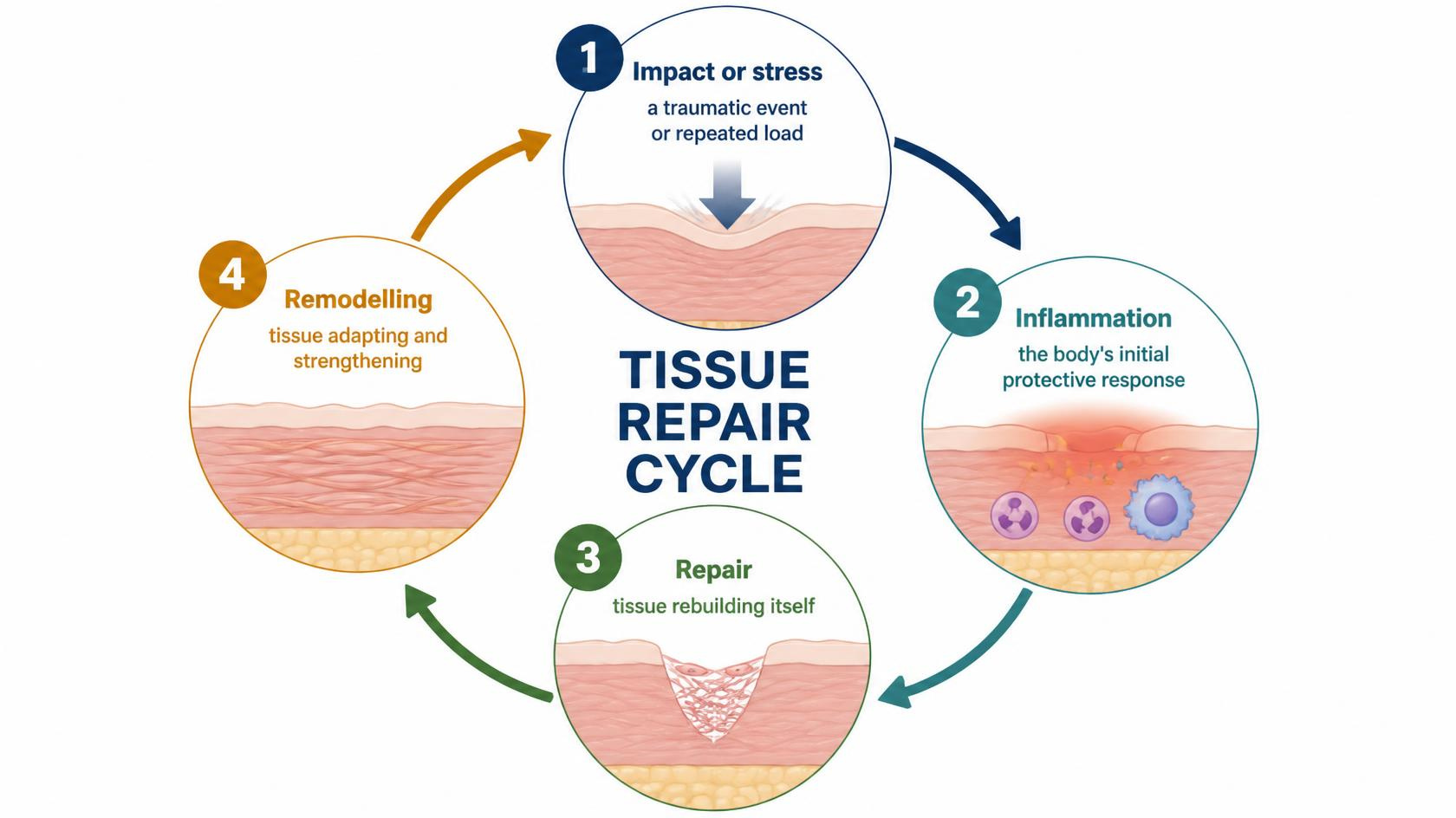
The Tissue Repair Cycle, Explained
Beneath the surface, tissue goes through a repeating cycle:
- Impact or stress — a traumatic event or repeated load
- Inflammation — the body's initial protective response
- Repair — tissue rebuilding itself
- Remodelling — tissue adapting and strengthening
When too much load is placed on a muscle or joint before it can properly complete this cycle, the process gets interrupted. The tissue never fully remodels before it's overloaded again. Over time, this creates a chronic, low-grade dysfunction that eventually surfaces as pain.
Why Treating the Painful Spot Alone Rarely Works
This is why addressing painful spots in isolation tends to produce only temporary relief. If hip and knee stiffness has gone unaddressed and continues, the lower back that's been compensating for it will likely flare up again — the pain simply relocates rather than resolving.
A thorough assessment looks past the site of pain to find:
- Where movement was lost first
- Why the body started compensating in the first place
- What's limiting recovery capacity — repetitive stress at work, a training habit, a period of poor sleep, or high stress
Getting to the Root Cause, Not Just the Symptom
Addressing pain when it shows up is important. But identifying and correcting the compensation patterns before they cause pain is even more valuable for long-term movement health.
Click here to learn about when is the right time to seek help.
frequently asked questions
| Why does my pain keep coming back after treatment? | If pain returns after treatment, it may be because the original site of compensation — often a stiff joint or restricted area elsewhere in the body — hasn't been addressed. Treating the painful spot alone can offer temporary relief while the underlying pattern remains. |
| Can you have joint dysfunction without pain? | Yes. Joints and tissues can lose normal range of motion well before any pain develops. The body often compensates for these restrictions using surrounding muscles and joints, which is why dysfunction can go unnoticed for a long time. |
| What does a chiropractic assessment actually look at? | A thorough assessment looks beyond the area of pain to identify where movement was first lost and why the body started compensating, considering factors like repetitive strain, training load, sleep, and stress. |
The Bottom Line
Pain is a late-stage signal, not the starting point. If you're dealing with recurring pain that keeps shifting or returning despite treatment, it's worth having your movement and compensation patterns properly assessed rather than just treating the site of pain.
Based in Moorooka or the surrounding Brisbane suburbs? If this sounds familiar, it's a conversation worth having next time you're in. Book an appointment with our team to find out what's really driving your pain.